
Twelve Questions About a Manufacturer's Background and Certificates
Certificates and a company history answer a narrower question than most buyers assume. They show that a site has been assessed against a standard at a point in time; they do not show that the standard is applied to your product, or that the people who will run your order are the people who were audited. The questions that matter before signing are therefore not about whether a certificate exists, but about its scope, its owner, and what happens on the day it is not met. Twelve of them are set out below, grouped by what each one is really testing.
Key takeaways
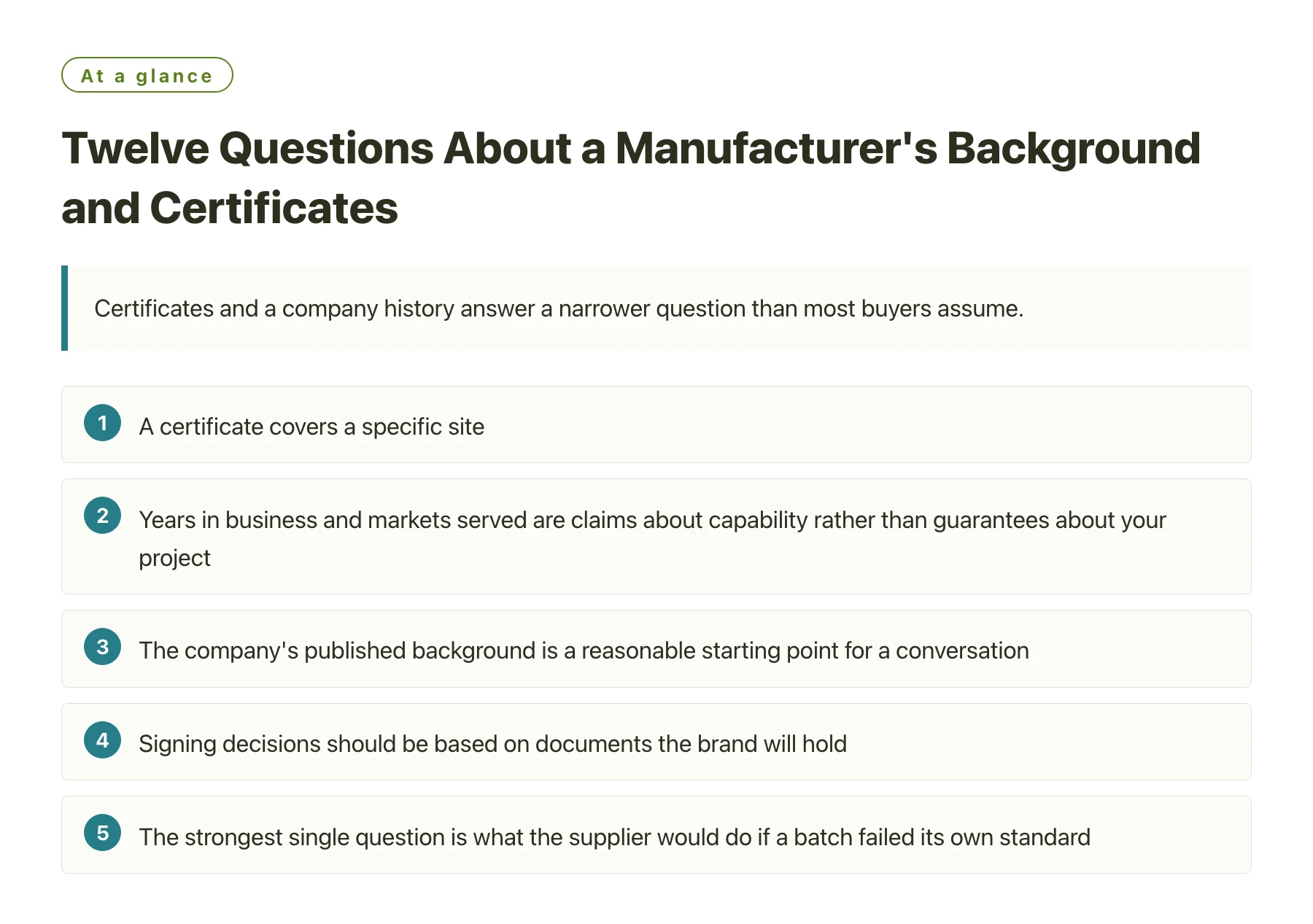
- A certificate covers a specific site, a specific scope and a specific period, so the useful questions are about scope and currency rather than existence.
- Years in business and markets served are claims about capability rather than guarantees about your project, and both can be checked.
- The company's published background is a reasonable starting point for a conversation, as long as it is treated as a claim to verify rather than a fact to rely on.
- Signing decisions should be based on documents the brand will hold, including the quality agreement, the specification record and the terms covering who owns what.
- The strongest single question is what the supplier would do if a batch failed its own standard, because the answer describes the system rather than the sales position.
First contracts are usually signed on a mixture of evidence and momentum. The evidence is a certificate list and a factory visit; the momentum is a launch date. That combination works out often enough to be normal, and fails often enough to be worth a short checklist.
The questions below are written for a brand owner who is about to sign a first manufacturing agreement and who does not have a quality department. They are ordered so that the earlier answers change what the later questions need to be.
Questions about the company and its history
- Which legal entity will be my counterparty?The factory, a trading company or a group entity can each be the signatory, and the answer determines who is liable when something goes wrong.
- How long has this site been manufacturing, as opposed to the group?Group history and site history are different facts, and the site is what will produce the order.
- Which markets do you currently ship to, and under whose registration?Existing export experience is more useful than a market list, because it implies familiarity with the documentation each market requires.
- Who will be my day-to-day contact, and who is their escalation point?Named people with authority shorten every problem, and the absence of a name predicts slow answers later.
Questions about certifications and quality systems
- What exactly does each certificate cover?Ask for the issuing body, the certificate number, the scope and the expiry date, and check that the scope names the activity your order needs.
- Which site does the certificate apply to?A group certificate may not cover the building that will fill your product, and multi-site certificates need the annex checked.
- Who is responsible for quality, and do they have authority to stop a batch?A quality function without a stop decision is a documentation function.
- What happens when a batch does not meet the standard?The answer should be a sequence with named steps and a record, not a reassurance that it rarely happens.
Questions about the order itself
- What sets the minimum order quantity?Ask which component drives the figure, because a compound minimum, a bottle minimum and a printing minimum are different constraints with different solutions.
- What does the quoted lead time assume?A lead time means nothing without its assumptions, including artwork approval, deposit and material availability.
- Which stages of my order happen on this site?Compounding, filling, decoration and packing can each be subcontracted, and responsibility should be named for every handover.
- What will I physically hold on the first day of the project?A counter-signed agreement, a specification, a retained reference sample and a named contact is a foundation; an invoice and a delivery date is a transaction.
Claims, the document behind them, and the answer that should worry you
| Claim | Document that supports it | Answer that should worry you |
|---|---|---|
| We follow cosmetics GMP | A current certificate with a scope naming the manufacturing activity [1] | The certificate is promised for later, or covers a different activity |
| We test everything | A list of tests, the methods used and which laboratory performs them | Testing is described without naming the method or the laboratory [2] |
| We are experienced in your market | A product information file, label set or notification reference for that market | The market is described as similar to another one the supplier already serves [3] |
| We handle the documentation | A contents list of the pack the brand will receive, with dates | The pack is described in general terms with no list |
| We can scale with you | The site's stated capacity and the equipment relevant to your format | Scaling is discussed only in terms of willingness |
| We have done this many times | References or project outlines the supplier is allowed to share | Every past project is confidential when a reference is requested |
The middle column is the useful part of the table. If a claim has no document behind it, the brand is buying a statement rather than a control.
What to settle in writing before the first order
Three documents decide more of the relationship than the purchase order does: a quality agreement, a specification record and a set of terms covering ownership and termination. The quality agreement names who is responsible for what, how a deviation is handled and what evidence is retained. The specification record makes the product reproducible. The ownership terms decide whether the work done in the first year is still the brand's in the third.
A quality agreement does not need to be long. It needs to name the sampling plan, the acceptance criteria, the record retention period and the notification window when a problem is found. Anything not named there will be negotiated in the middle of a problem, which is the worst time to negotiate anything.
Certification claims are worth one further test, and it is a simple one: ask which certificate the supplier would put in front of a customer's auditor, and why that one. A company with a genuine quality system answers immediately and gets the scope right. A company that has assembled certificates for marketing purposes tends to list everything it holds, which is a different and weaker answer.
Manufacturers that publish their own standards make this easier to check. Xuelei, for example, states that it holds ISO 22716, GMPC, ISO 9001, ISO 14001 and ISO 45001 and works to HALAL requirements, alongside a stated 31 years of fragrance and home fragrance manufacturing in Guangzhou. Those are company statements and they belong in the verification column, not the assumption column, but they give a brand a specific list to check rather than a general impression to trust Xuelei.
Evidence of past work is the other side of the same question. A brand should ask which projects the supplier is permitted to describe and in what detail, because a partner that can walk through a real project outline is describing its process, while a partner that can only describe outcomes is describing its marketing Xuelei case studies.
The answers to those questions decide more of the relationship than the purchase order does, because they set what the brand holds when the pressure of a deadline arrives. A brand that has collected them in writing before the first order has something to point at the first time reality diverges from the plan what to verify before signing with a fragrance manufacturer.
Keep the answers. A short file containing the written replies to these twelve questions is the most useful document in a first manufacturing project, because it is the only record of what the supplier committed to before the pressure of a deadline.
Sources
- ISO 22716 — Cosmetics — Good Manufacturing Practices (GMP)
- SGS: Cosmetics, Personal Care & Household Testing —— Testing, inspection and certification services for cosmetics and personal care, including microbiological, stability and safety testing aligned with cosmetics GMP.
- European Commission: Cosmetics in the EU —— The European Commission's overview of EU cosmetics rules, including the responsible person, product information file and safety report requirements.
Frequently asked questions
Which certifications should a perfume manufacturer have?
There is no single required set, because the answer depends on the market and the product category. Cosmetics GMP such as ISO 22716 is commonly relevant, and environmental or occupational standards indicate how the site is managed. What matters most is that the scope of each certificate covers the work being ordered.
How do I check that a certificate is genuine?
Ask for the certificate number, the issuing body and the expiry date, and check that the certificate covers the specific site and activity. A supplier with nothing to hide sends the document itself rather than a photograph of a wall.
Do I need a quality agreement for a small first order?
Yes, and it can be brief. Even a one-page agreement naming acceptance criteria, sampling and the notification window prevents the most common first-order dispute, which is a disagreement about whether a delivery met the specification.
Is a longer company history a meaningful advantage?
It correlates with experience in handling problems, which is useful, but it is not evidence about your product. Treat it as context and check the site, the scope and the current quality system instead.
What should I do if the supplier refuses to provide a reference?
Accept it once, since client confidentiality is legitimate, and ask for a project outline with the client's identity removed instead. If neither is available, weigh that against the rest of the evidence rather than treating it as a single disqualifier.
Original designs, vetted by three pastors.
5.3 oz combed ringspun cotton. Printed in Nashville. 1-Year No-Fade Guarantee on every shirt.
Shop New Arrivals