
Low MOQ Custom Jewelry Wholesale: What 50 Pieces Buys
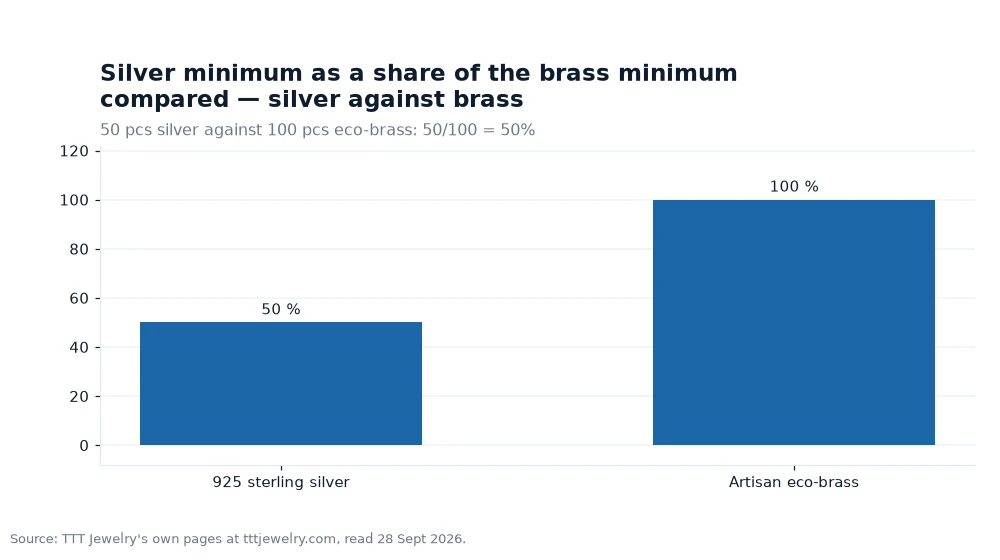
Fifty pieces is the published per-design minimum for 925 sterling silver at TTT Jewelry, half the 100-piece artisan eco-brass minimum and the smallest entry point in the range. What that number buys is one design, one mould, one sample approval and one plating batch — not fifty variations on a theme. Understanding the difference is what stops a first order from becoming three half-finished ones.
Key takeaways
- Silver enters at 50 pieces per design; brass starts at 100 and stainless steel at 100+.
- Fifty silver pieces equal 50% of the brass minimum, so the entry point sits at half the unit count.
- One design carries one CAD file, one sample approval and a 25–30 day sampling block.
- 100% inspection applies at 50 pieces, so the run is checked piece by piece.
Why the silver minimum sits at 50
The published numbers are 50, 100 and 100+, and the ratio between the first two is clean: 50/100 = 50%. The figures state the entry point rather than explain it, so a buyer should treat the ratio as a planning fact and ask what a second 50 pieces would actually change. In most cases it changes the plating load and the inspection count, not the mould.
That distinction is the whole game at low volume. A 50-piece silver run is one mould, one CAD file and one approval trail. The buyer's leverage at that size is depth: one design finished properly, one finish checked in daylight, one pack that looks deliberate on a shelf. The 100+ figure for stainless works differently again, because that alloy takes PVD vacuum plating, and the stainless steel jewelry manufacturer pages set out the process that makes the piece shower-safe.
One design, six decisions
The six customisation blocks do not shrink with the order. Base material is settled by the minimum, but plating still has to be chosen from rhodium or multi-layer 14K, 18K or 24K gold, with an anti-tarnish e-coating over silver and brass. Chains and findings still need a clasp decision. Stones and accents still need a type and a size, whether that is natural stone, freshwater pearl or CZ. A hallmark still has to be engraved as S925, and packaging still needs a box, a pouch, a backing card and a barcode label.
Each of those six is a decision with a document behind it. Fifty pieces need a hallmark position drawing, a physical colour standard and a dieline exactly as a larger run would. The buyer's workload is fixed by the number of blocks, not the number of units, which is why a small first order feels disproportionately heavy on admin.
Plating deserves isolating because it is the block that most often forces a second approval. A colour reference signed off on a screen will not match a rhodium or 14K gold bath, and the correction is not a new design but another plating pass. At 50 pieces one pass is the entire run, so the colour has to be agreed against a physical standard before the batch enters the line.
What fifty pieces covers
Read the table as a boundary map. Everything in the middle column is inside a 50-piece silver order; everything on the right needs either more units or a separate approval.
| Item | Inside a 50-piece run | Needs more |
|---|---|---|
| Designs | One design in silver | Three designs mean 150 pieces |
| Metals | 925 sterling silver | Brass starts at 100, stainless at 100+ |
| Sample rounds | One master sample | A second round adds 25–30 days |
| Finish | One plating colour per run | A second colour needs its own approval |
| Packaging | One box and pouch design | Extra pack formats need their own artwork |
| Inspection | 100% of 50 pieces | No sampling shortcut at low volume |
The last row is the one buyers misread. A small run is not lightly inspected; it is inspected in full, piece by piece. Final QC at TTT Jewelry is 100% inspection regardless of order size, so 50 pieces means 50 checks and a defect found at unit 49 still holds the shipment.
Depth beats breadth at the entry point
Brands building a first custom jewelry wholesale order tend to ask whether the minimum can be split across a small range. It cannot: 50 pieces per design means two silver designs are 100 pieces in total. The quantity is per design, so the only real choice is whether to spend the entry point on one strong piece or on two weaker ones with twice the approval work.
One strong piece also gives a cleaner read on the supply chain. A single design exercises casting, setting, polishing, plating, hallmarking and packing in one pass, and any weakness in that chain shows up in a sample the buyer can hold. It also produces one set of launch assets: fifty pieces can be photographed, weighed and worn by a small retail partner long before a second design is tooled, and those photographs sharpen the next brief. For a wider view of what the entry point includes, explore more on the wholesale pages before fixing the design count, because the quantity decision shapes every later one.
Worked example
Route A is three silver designs at 50 pieces each: 3 × 50 = 150 pieces, three moulds, three CAD files and three sample approvals. Route B is one silver design at 50 plus one brass design at 100: 50 + 100 = 150 pieces, two moulds and two approvals. The unit total is identical and the approval load is not — three trails against two.
The calendar per design is 2 + 25–30 + 21–28 = 48–60 days. Parallel sampling does not triple the bench window when designs share a plating line, but it does triple the review decisions, and one rejection puts a third of Route A back by a full 25–30 day block. Now measure that against a 12-week season of 84 days: a 48–60 day chain consumes 48/84 = 57.1% to 60/84 = 71.4% of the selling window, leaving 24 to 36 days of shelf life before the next drop has to be ordered.
Frequently asked questions
Can the 50-piece minimum be split across two designs?
No. The minimum is quoted per design, so two silver designs mean 100 pieces in total, 50 of each.
Does a small order move through fewer stages?
No. The published stages stay the same: under 48 hours for CAD, 25–30 days for sampling and 21–28 days for bulk production. A 50-piece run saves inspection repetitions, not approval steps.
Is custom packaging possible at 50 pieces?
Packaging is a separate block with its own artwork and quantities. Fifty pieces can carry a custom box, pouch and backing card, but the print and labelling details need approval before the packing date.
Start narrow, then widen
A 50-piece order is a test of the whole route, not a discount version of a large one. The mould, the sample, the finish and the pack all get built once, and the lessons from that single pass decide what a second design should be. Buyers who plan a range over several seasons often begin with one silver piece and add metal routes only after the first sample has been worn and photographed. The sterling silver jewelry manufacturer pages are a useful reference at that stage, because the silver route carries the smallest per-design threshold in the published range.
Source note: figures come from the manufacturer's own website (tttjewelry.com), read 28 Sept 2026.[1]